Sunday, November 29, 2009

Book 9: Wolf-Speaker by Tamora Pierce

As you can probably guess, this is the second book in Tamora Pierce's Immortals series. As the sequel to Wild Magic, Wolf-Speaker follows Daine's adventures in Tortall with her teacher, Numair Salmalin. In this novel, Daine receives a summons from the Long Lake wolf pack--wolves who once served as her surrogate family following the murder of her mother and grandfather--requesting her help with the human lords of the Dunlath Valley who are systematically destroying the area. However, once there, Daine and Numair find that not only is the environment surrounding the Fief of Dunlath being damaged, but there is also something else awry--and it stinks of high treason on the parts of the lord and lady of Dunlath who are, along with mages and Immortals from the southern empire of Carthak, attempting to overthrow the King and Queen of Tortall.
Daine and Numair become separated from one another and have to work alone to try and stop Yolane and Belden's treacherous plan before they destroy the valley--or worse, succeed at their plot.

This novel further develops the theme of animosity towards Tortall from the Emperor of Carthak, which becomes the primary theme in the last two books of the series. In this novel, Daine's powers also expand from simple communication with animals to the ability to heal them and enter their minds, and later transform completely.

Unlike the first book in the series, Wolf-Speaker is more of a straight-up adventure story and doesn't have nearly as much emotional and relationship development as Wild Magic did. While it was still a pleasant read, it was significantly less engaging than Wild Magic is and in my opinion almost expendable in the grand scheme of the series. Even so, Wolf-Speaker is not lost on the reader; anyone who enjoyed Wild Magic will like Wolf-Speaker as well.

Grade: B+
Rating: 10+ (advisory: mild violence)

Saturday, November 28, 2009

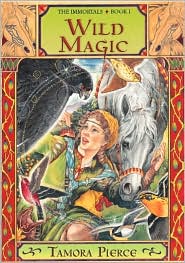
Book 8: Wild Magic by Tamora Pierce


This is a ridiculously long post (I have a long history with this book, so be prepared for storytime if you decide to read the whole dratted thing). If you're just here for the review, scroll until you see the big purple letters.

Anyway.

I picked this book up for the first time when I was in sixth grade, not knowing that it would be responsible for shaping my reading habits for the next three to four years. I devoured it and its sequels before moving on to the author's other books, and then obsessively re-read them again and again. The spine on my copy of this one is absolutely destroyed, which could be credited to the fact that it's a used book, but I choose to peg it on the fact that, once upon a time, it was the most-oft-read book on my shelf.

I generally expect books to lose their charm after a few years, and most of the time they do. There are a few exceptions I've found--Gail Carson Levine's Ella Enchanted, for example, or the first of J.K Rowling's Harry Potter Series. No matter how many times I read them, these books never get old. They are just as beloved to me now at nineteen as they were when I first read them as a fourth grader. Personally, I think that is a great feat of writing, and something that authors should be heartily congratulated on. It's easy to go from adoring a book one day to thinking that it isn't anything special the next, especially given the extreme power that public opinion has these days (hello, Twilight? I read it when it was a cool, cult-indie book. Now I wouldn't be caught dead carrying that one around in public; my apologies to Stephenie Meyer).

As I steadily read my way through Tamora Pierce's books, and as I got older, a litany of complaints with her writing sprung up in my head and stayed there, so that long after I stopped reading her books and moved on to more of the "serious literature" that my parents implored me to read instead, I still harbored a strange disdain for her and her work.

Of course, all of my criticisms of her work were completely justified. I still maintain that her later work is not nearly as good as her first couple series, and that her characters tend to become anti-stereotypes (ex: the bad-ass queen who bags bandits on horseback in taffeta ball gowns) and the kingdoms she "creates" are eventually very easy to identify as direct copies from real, existing countries. BUT, in my haste to "move on" and cover my tracks as one of the formerly Tamora Pierce-obsessed, I think I might have gone a little too far.

It had been years since I'd even paid a real thought to Tamora Pierce when I desperately grabbed Wild Magic off of my bookshelf as I left home on my way to the airport during a recent holiday from college. Last year, I came to school laden with books that I intended to read over the course of the school year. But at the end of the term, I hadn't properly finished even a single one. So this time when I packed to head back to school all the books I brought were academic, sparing two, and even those two aren't all that compelling as far as novels go. I read enough of the heavy stuff for my classes, so when I'm looking for some bedtime reading, I definitely don't turn to Feynman's Six Easy Pieces or Nehru's biography for a literary lullaby (unless I wanted to either bore myself to sleep or be lulled by words that are too big for a sleepy 2AM brain). When I look for a book to keep myself happy and entertained, especially nowadays, I find that I'm more likely to turn to the old faithfuls.

I started reading Wild Magic on the plane flight back to school, and was pretty surprised to find that it was more or less as good now as it was when I first read it. I suppose it was unexpected because of all the mental bashing I'd done of Tamora Pierce's work, but the characters still sprang out of the page and the plot still gripped like it used to. Granted, I'm now painfully aware of all the weird, unnecessary, annoying things that Pierce does with her writing, but I'm also willing to overlook all of that for the sheer enjoyment I got out of readingWild Magic. As my friend Eldridge so aptly described it, reading an easy, fun novel like that is like a brain massage--and goodness knows I need as many of those as I can get this year! I finished the book feeling rejuvenated and, for the first time in a while, excited about reading. It's been too long since I've wanted to find an excuse to pick up a book (I went so far as to go to the gym and work out for a good hour just so I could read while doing so).

Anyway, on to the review. God, this has been a long-winded post.

Alright. So, Wild Magic and its three sequels follow the adventures of Veralidaine "Daine" Sarrasri (Ridonkulous name? Yes, I think so) as she attempts to find her way in the kingdom of Tortall after her escape from her village in the country of Galla. She is young--about thirteen--, pretty, and a skilled archer. Her best friend is a ornery pony named Cloud. We quickly learn that she is an orphan (her family was killed by bandits) and that she has what she calls a "knack with animals". She meets Onua, the woman responsible for choosing horses and ponies for the Tortallan Royal Stables, and gets hired on to be her assistant. Together, the two lead the new herd of ponies south towards Tortall, getting into their share of trouble along the way.
With the help and tutelage of Tortallan mage Numair Salmalin, Daine discovers that she possesses wild magic, a rare type of magic that gives her a connection to animals (among other things). She learns to tap into it, and tackles her difficult past along the way. As her magic becomes stronger, Daine realizes that she can sense the presence of and communicate with Immortals--mythical and often dangerous creatures that were banished to the Divine Realms hundreds of years ago by mortal mages. This skill proves very useful when it comes to light that meddling sorcerers have begun releasing the immortals into the Mortal Realms. The story comes to a head when she and her new friends are attacked by raiders intent on the destruction of the Tortallan royal family. With the help of her magic, Daine helps save the day and discovers herself at home in a new country.

Wild Magic was and still is a fantastically satisfying read. I recommend it to anyone above the age of 10, and especially to those fantasy-inclined (but reluctant) readers. Tamora Pierce's work is both fun and easy to read.

Grade: A
Rating: 10+ (advisory: violence)

Thursday, October 15, 2009

Life Update 3

It's been raining around here for the last few days.  Of course, "raining" is a relative term in Southern California.  In the past 48 hours, we had approximately 3 minutes of torrential downpour.  Other than that, the sky was gloomily but innocuously cloudy.  We barely even got drizzled on.  
And, of course, I woke up this morning to perfectly blue skies.  It's supposed to hit 95 degrees tomorrow.  Claremont weather is so completely on drugs.  I hear it's supposed to be an El Nino year.  Maybe that means we'll get more than, um, half the national average rainfall this year (National average = 38 inches per year.  Claremont average = 18 inches per year.  Awesome.  That's what we get for living in a desert).  
I have to admit, I miss rain.  Even though we don't get a terrible lot of it in NorCal either, it's better there than it is here.  I love ferocious rainstorms.  We saw a grand total of ONE of those last year in Claremont.  Good times.  
I've been considering getting some of those ridiculous rainboots that all SoCal girls seem to be rocking around this time of year.  They're so adorable, but I'm pretty sure I'd only get about 3 uses out of them in the year, so it would be a pretty impractical purchase.  -sigh- 
I'll be putting my life in OChem's hands once more tomorrow, since our third midterm starts bright and early at 8AM.  Having only 9AM classes last year made it easy to forget the horror of having to get to class at 8:00.  Now that I have to do it again, I can't for the life of me remember how I managed it in high school.  I am convinced that high school students (and, indeed, any students who wake up at 6:30 on the daily) are superheroes.  

Sunday, September 20, 2009

Book 7: Austenland by Shannon Hale

I'm not sure if I've made this adequately clear in the past, but I am not a huge fan of Jane Austen's.  While her stuff is, yes, entertaining to a degree, I can't help but feel like every story is the same and every character is just a reconstituted Mr. Darcy or Ms. Bennett.  And, yeah, her characters sometimes have rather witty, snarkastic (sarcastic + snarky; I think it's clever) things to say, but nothing from a Jane Austen novel has ever inspired me to love, admire, or even loathe her characters.  
In light of this, I find it highly amusing that Shannon Hale's Austenland, a novel entirely concerned with Jane Austen and the women who love her work, is one of my favorite frivolous reads of all time.  I say "frivolous" simply because, having read a few of Hale's other novels, I can safely call Austenland one of her more playful endeavors (it's meant to be funny and ridiculous, unlike Goose Girl which is much more literary in nature, for lack of a better description).  
The plot of Austenland is as follows:  Jane Hayes is a successful working woman living in New York.  She has, it seems, everything a girl wants--beauty, youth, a good job.  Everything, that is, except a healthy love life.  Jane is a Pride and Prejudice addict of the highest order and a lover of everything Jane Austen.  And she is obsessed--OBSESSED--with Mr. Darcy.  No real boyfriend could possibly compare in her eyes to the perfection that is Fitzwilliam Darcy.  It's a guilty habit--one she's aware of and knows, on some level, that she has to get rid of if she wants to move on with her life.  So when a recently-deceased relative wills her an all-expenses-paid trip to an English resort built specifically with her type in mind--that is, a three-week immersion in a re-creation of Regency England that caters to the Austen-obsessed--Jane decides to go on the eccentric vacation for one last hurrah before dumping the Darcy habit for good. 
For three weeks she dresses in ball gowns, learns the talk and the manners, dances, and interacts with Martin the Gardener and the broody Mr. Nobly (or is it the actors they're played by?) and the other vacationers, and she eventually finds herself in her element, thriving in the synthetic setting and loving it.  The true question by the end of the vacation is this:  will she bid Pembroke Park adieu having left the obsession in the past or will she, perhaps, end up with a flesh-and-blood Mr. Darcy of her own? 
It's a seriously delightful novel, and a very quick read.  It's chick-lit, to be sure, but even the most straight-laced readers will have to laugh and sigh with the believable and relatable character that Hale creates in Jane Hayes.  The narrative reads with an ease and a wit that I really can't get enough of.  
Yeah, maybe it does have a happy ending, but it's so much better than that.

Grade:  A+
Rating:  14+ for (ew omgsh) making out, etc.

Saturday, September 19, 2009

Book 6: "Covering: The Hidden Assault On Our Civil Rights" by Kenji Yoshino


Since I'm part of the housing staff at my college, I'm supposed to read the summer reading book that the college assigns to incoming freshmen so that I can discuss the book with the freshies when they get on campus.  

I picked the book up before school let out, and started reading it during the train ride to the beach on my last day in Southern California.  While the material was relatively interesting, I only got through the first few pages before falling asleep (credit for the doze-off goes to the groovy motion of the train, though, not the book).  

I was recently reminded of the task I had been charged with, and since I didn't have anything to read, I picked this one back up.  

Covering:  The Hidden Assault On Our Civil Rights is a memoir/essay by Kenji Yoshino on the broad subjects of identity and society.  More specifically, it's about society's demands for conformity through an act which Yoshino calls "covering".  Covering is defined as the process by which people "tone down" or de-emphasize stereotypes or stigmas associated with their racial, gender, sexual, religious, or other identities.  According to Yoshino, one can cover along the four axes of appearance (by making sure we don't look stereotypically ___), affiliation (by not associating with ____ culture), activism (by not engaging in ____ causes), and association (by keeping a distance from other ____ people).  

  Aside from addressing a very interesting and current topic, Yoshino does a great job of building  the book into a delightful cross between an expository essay and a memoir.  By using his own experiences as fodder for the discussion of covering, Yoshino builds context and provides resonant parallels between his life and the sociopolitical precedent that legitimizes covering in American society.  I found the format in which Covering was written to be very effective in not only giving readers a reason to care about the subject, but also in forcing readers to think about how they themselves capitulate to and impose covering demands.  Yoshino's style is also very appealing to me, in that he neatly balances the flourish of more formal, lyrical writing with a very frank, honest discussion of the issue and its effects.  He is also very even-handed, and seems to never make the mistake of taking himself too seriously--a quality that I respect very much in a writer.  

Professor Yoshino actually came and spoke at my college on the subject of covering, and I was pleased to find that he is as well-spoken in the flesh as on the page.  (He also dresses excellently, but that's quite besides the point)

I think Covering is one of those books that everyone should read, both for the purpose of better understanding society and to, more importantly, gain better understanding of the self.  Covering is an issue that touches everyone, and understanding it helps us know how it relates to us and influences our place in the world.  


Grade:  A
Rating:  15+; it would probably bore anyone younger
Considerations:  None.  It's appropriate for just about everyone

Wednesday, September 2, 2009

Life Update 2

Things have been pretty crazy of late.  I'm back at school now, and it's only just hit me how crazy this semester is going to be.  Still, things are good.  I like my classes (or, rather, I like them as much as I am able, given that Organic Chemistry has officially put its devil mark upon my brain as of today), I love my room (it's GIGANTIC and all mine), and I adore my freshmen.  I hope they like me as much as I like them.  
It's been insanely hot here in Claremont, though right now it's pleasant and cool in my room (the breeze blows in through the balcony door once in a while and it really is the most exquisite thing).  The local fires are burning themselves out slowly, so the air quality is gross.  I find ash on the balcony in the morning sometimes, and smoke clouds rise out of the North and make me think of Mordor every time I turn towards the mountains.  
According to my freshmen, a "blonde guy" keeps showing up at my door when I'm not around.  I have no idea who this person is, since he's never left me a note to indicate his identity despite the fact that a good portion of my door is taken up by whiteboard.  Hopefully he'll come by while I'm here and solve the mystery.  That would be good.

Friday, July 24, 2009

Book 5: La Cucina by Lily Prior


I feel bad for hating on this novel, since it is technically the sort of book I should like.  It's about Italy, it contains stellar recipes, it's got a neat front cover (sold!).  But, if I had a five-star rating scale, this book would get a whopping two.  I found La Cucina by Lily Prior lacking significantly in the uniqueness and stylistic grace that makes other books of its kind so much fun to read.  

This book is the sexed-up, slightly demented lovechild of Under The Tuscan Sun and Like Water for Chocolate (both are excellent books, so it's a pity that they have such an odd pseudo-offspring).  While the other two books handle the topics of family, hardship, and love in a classy and novel manner, La Cucina feels like it's been done before and, moreover, is just plain awkward to read.  Within the first couple of pages, the narrator is talking about lying naked on a table and going into discourse on the subject of the virility of the locals' loins.  

DO NOT WANT.     

Don't get me wrong--I'm not a prude by any standards and, to be fair, the back cover of the book did prepare me adequately for the general content.  Food and sex are deeply intertwined in this book; the two are explored together in all varieties of visual media (see photography byGeorgia O'Keefe, or the Japanese film "Tampopo"), so it isn't at all an unnatural pairing.  What weirded me out was the style, the manner in which these themes were discussed.  There is a lot of what I have termed "sexytime" in this book (I'm sure you can figure out what that means).  I generally  have no problem with literary sexytime.  The problem with this novel is that the sexytime isn't...sexy.  Or sensual.  It's the kind of sexytime that makes your (or, at least, my) skin crawl.  

But, hey, maybe the problem is with me.  As a member of the younger generation, I don't have any relish for expostulation upon the mating rituals of the elderly (which, of course, is the nature of sexytime in La Cucina).  Perhaps I just have some growing up to do before this will be a relevant/appealing read for me.  In that case, I suppose your enjoyment depends on who you are and where you are in life.  I'm just not there yet.  Despite the richness and flavor of certain sections of the novel, I couldn't ignore the painful awkwardness long enough to properly enjoy what I was reading. 

Anyway, on to the plot!  

La Cucina follows and is narrated by Rosa Fiore, a farmer's daughter from the Italian countryside.  Rosa is a talented and passionate cook, and her knack for the culinary arts introduces and sustains food throughout the novel as a medium for her self-expression and emotional catharsis (hence the similarity to Like Water For Chocolate).  As a teenager, she falls in love with Bartolemeo, the son of a Mafioso who has already been promised to another by his father.  Though Bartolomeo loves Rosa in kind, their romance comes to a tragic end, which results in a grief-stricken Rosa exiling herself first to her kitchen and later to the city of Palermo where she lives and works as a librarian.  It is only years later in her life, after she has resigned herself to a loveless existence and grown fat on the richness of her cooking, that she meets an Englishman (who is referred to only as "L'inglese"--literally "the Englishman"--throughout the novel) who makes her discover not only the full extent of the pleasures of food, but also the pleasures of the body.  
But, of course, love can't last.  More disaster strikes and, in the wake of yet another loss, Rosa returns to her hometown where family drama (including a who's-the-daddy twist) awaits her.  Despite this, though, the novel ends on an optimistic note, leaving Rosa's future happiness up for the reader to imagine.  

The awkward handling of sex as a theme in La Cucina wasn't exactly my only problem with the novel.  The characters feel more like caricatures, lacking depth and originality.  Though the story was decent, the narrative was sadly lacking.  I generally wouldn't recommend it, but if you're determined to read it, be aware that there is a good deal of strong language used, as well as a few relatively explicit sex scenes.  

The tagline of the title is "A Novel of Rapture".  Sorry, Lily Prior.  I really wasn't feeling it with this one.